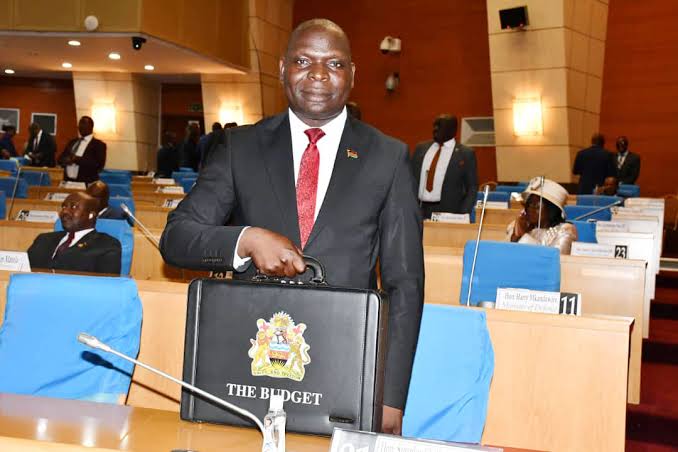
Malawi’s government has unveiled an ambitious K8.05 trillion national budget for the 2025/2026 financial year, aiming to stabilize the economy, enhance social protection, and invest in infrastructure development. This budget represents 31.1% of the country’s Gross Domestic Product (GDP), reflecting the government’s commitment to addressing pressing economic challenges.
Debt and Fiscal Realities:
The country’s public debt has reached K16.19 trillion, accounting for 86.4% of GDP, with K7.39 trillion as external debt and K8.79 trillion as domestic debt. Interest payments are projected at K2.17 trillion, nearly half of the estimated domestic revenue, posing significant fiscal constraints. The government acknowledges that a substantial portion of the budget will be directed towards servicing past debts, wages, and pensions, leaving limited resources for development projects.
Key Allocations:
- Education and Skills Development: Allocated K1.3 trillion (16.6% of the total budget) to finance classroom construction, university infrastructure, student loans, and curriculum reforms.
- Health and Population: Allocated K741.05 billion (9.2%), covering hospital construction, health posts, and the completion of the National Cancer Centre.
- Agriculture: Allocated K693.3 billion (9%), including K131.6 billion for the Affordable Inputs Programme (AIP), K99.5 billion for Irrigation Development, and K38.3 billion for Mega Farms projects.
- Infrastructure Development: Allocated K422.3 billion to support key projects such as the Marka-Bangula railway line, road upgrades, and the modernization of Kamuzu International Airport.
- Malawi Electoral Commission (MEC): Allocated K162.9 billion to prepare for the 2025 Tripartite Elections, marking a 207% increase from the previous year.
Economic Growth and Production:
The government anticipates a 3.4% GDP growth rate in 2025, driven by increased investments in agriculture, tourism, mining, and manufacturing—the cornerstones of the Agriculture, Tourism, Mining, and Manufacturing (ATMM) strategy. Key investments include irrigation development to stabilize maize yields, expansion of Mega Farms to boost agricultural exports, operationalization of the Malawi Mining Investment Company to formalize gold mining, and increased funding for tourism promotion to enhance foreign exchange earnings.
Social Protection and Inclusion:
The government has reaffirmed its commitment to social welfare with allocations such as K42.5 billion under the Constituency Development Fund, translating to K220 million per constituency; K33.5 billion for drug procurement in local councils; K188.5 billion under the Malawi Social Support for Resilient Livelihoods Programme; and the Social Cash Transfer Programme targeting 382,457 vulnerable households.
Challenges and Risks:
While the budget outlines ambitious targets, concerns persist over the rising public debt, projected inflation at 22.3%, and the heavy reliance on domestic borrowing to finance the deficit. The overall fiscal deficit is estimated at K2.47 trillion (9.5% of GDP), with K2.33 trillion expected to be borrowed from domestic markets. The government’s ability to mobilize external grants, projected at K1.14 trillion, will be critical in cushioning the fiscal deficit.
In summary, while the K8.05 trillion budget demonstrates the government’s efforts to stabilize and grow the economy, it also underscores the need for prudent fiscal management to address rising debt levels and ensure sustainable economic development.
Sources: www.nyasatimes.com, www.times.mw